

Global Shutter vs Rolling Shutter in Image Sensors
1. Rolling Shutter
Rolling shutter, denoted as Rolling Shutter, is characterized by the sequential exposure of CMOS pixels (diodes). In this method, CMOS pixels are exposed one after another, which allows for higher frame rates. However, a drawback is that when the subject moves rapidly, issues such as partial exposure, skew, and wobble may occur.
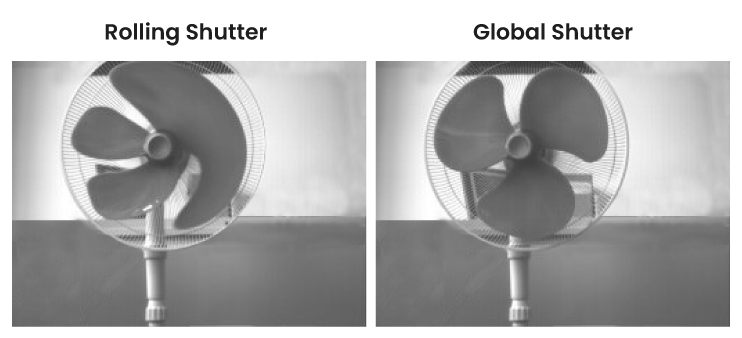
For example, the rotating blades of a propeller may exhibit image distortion due to the rolling shutter effect.
2. Global Shutter
Global shutter, also known as Global Shutter, is defined by the entire scene being exposed simultaneously. All sensor pixels (diodes) collect light and are exposed at the same time. Unlike the rolling shutter, this simultaneous exposure method eliminates the “jelly effect.”
CCD sensors operate on the global shutter principle, where all pixels are exposed simultaneously.
However, global shutter also has its disadvantages. It is well-suited for applications with short exposure times (e.g., <500 μs), but when the exposure time is longer (e.g., >500 μs), noise becomes more significant, making rolling shutter more suitable in such cases.
Definition of Shutter
A shutter is a mechanism in a camera that controls the effective exposure time of the photosensitive medium. It is a critical component of a camera, and its structure, design, and functionality are key indicators of the camera’s quality. Generally, a wider range of shutter speeds is preferable. Shutter speeds are measured in seconds, with shorter durations suitable for capturing fast-moving subjects. For instance, some cameras boast shutter speeds as fast as 1/16,000 second, enabling them to freeze rapidly moving objects. Conversely, for capturing scenes like nighttime traffic or creating the silky effect of flowing water, longer shutter speeds are required.
Shutter Speed
Shutter speed is measured in seconds. Common shutter speeds include: 1, 1/2, 1/4, 1/8, 1/15, 1/30, 1/60, 1/125, 1/250, 1/500, 1/1000, 1/2000, etc. The exposure difference between adjacent shutter speeds is one stop. For example, 1/60 second allows twice the exposure of 1/125 second, meaning 1/60 second is one stop slower or lower than 1/125 second.
- Global Shutter
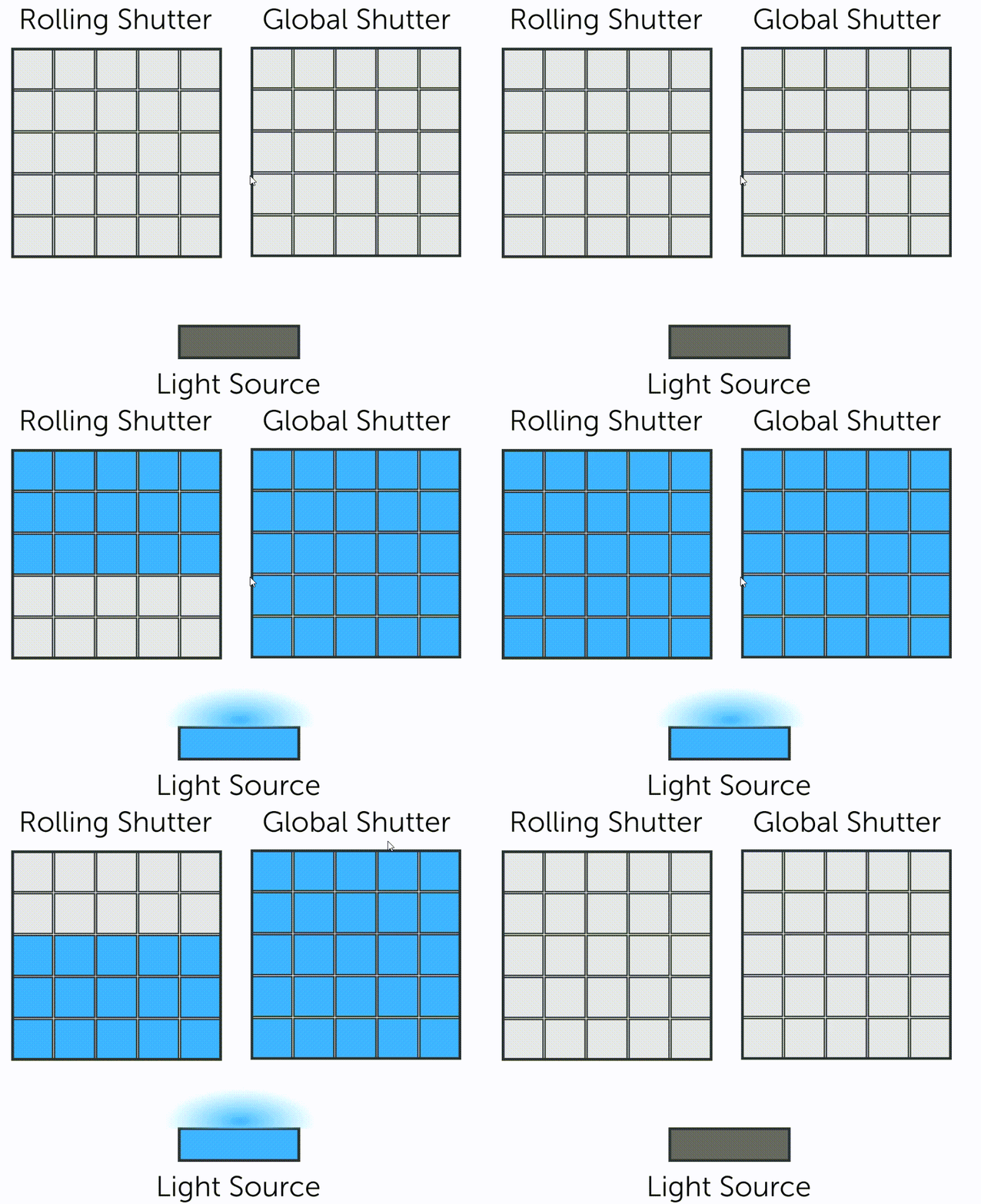
Global shutter achieves exposure by capturing the entire image simultaneously. All pixels of the sensor collect light and are exposed at the same time. Once the preset exposure time elapses, the sensor stops collecting light and converts the exposed image into an electronic image. There is no physical shutter involved in this process. At the start of exposure, the sensor begins collecting light, and at the end, the light collection circuit is cut off. The sensor’s readout value then constitutes a complete image.
- Rolling Shutter
Rolling shutter operates by exposing the sensor row by row via a control chip. Like global shutter, there is no physical shutter. Instead, the sensor’s sensitivity to light is controlled by powering on and off different parts at different times, exposing rows sequentially until all pixels have been exposed. The entire process is completed in a very short time, typically between 1/48 and 1/60 second.
Advantages and Disadvantages in SLAM Applications
- Rolling Shutter:
Due to its row-by-row sequential exposure, rolling shutter is unsuitable for capturing moving objects. If either the object or the camera is moving rapidly during shooting, the result may exhibit “skew,” “wobble,” or “partial exposure.” - Global Shutter:
Since all pixels are exposed simultaneously, global shutter effectively freezes moving objects, making it ideal for capturing fast motion. However, global shutter may suffer from motion blur. Whether motion blur occurs depends on the length of the exposure time. If the exposure time is too long and the object is moving quickly, motion blur may appear. If the exposure time is very short, the moving object is frozen instantaneously, minimizing motion blur.
What Is a Shutter?
A shutter is a mechanism in a camera that controls the effective exposure time of the photosensitive medium. It is a critical component of a camera, and its structure, design, and functionality are key indicators of the camera’s quality.
What Is Global Shutter (Total Shutter)?
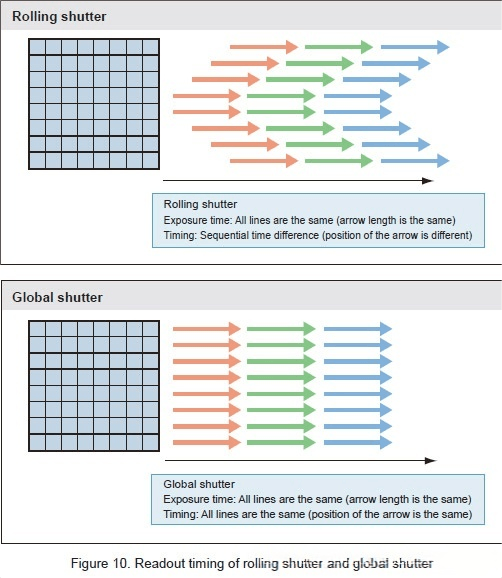
Global shutter exposes the entire scene simultaneously. All sensor pixels collect light and are exposed at the same time. At the start of exposure, the sensor begins collecting light; at the end, the light collection circuit is cut off. The sensor’s readout value then forms a complete image. CCD sensors operate on the global shutter principle, where all pixels are exposed simultaneously.
What Is Rolling Shutter?
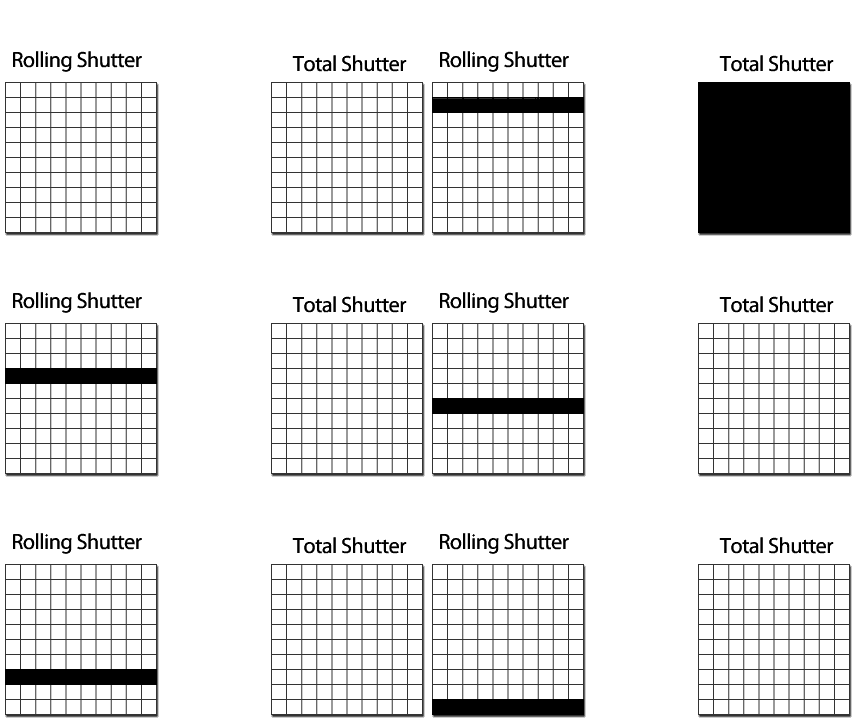
Unlike global shutter, rolling shutter achieves exposure by scanning and exposing the sensor row by row. At the start of exposure, the sensor begins scanning and exposing rows sequentially until all pixels have been exposed. The entire process is completed in an extremely short time, with different rows of pixels being exposed at different times.
Disadvantages
- Global shutter allows for shorter exposure times but may increase readout noise.
- For camera manufacturers, rolling shutter enables higher frame rates. However, improper exposure or fast-moving subjects may result in partial exposure, skew, or wobble. These phenomena, caused by the rolling shutter method, are defined as the “jelly effect.”
Global shutter is suitable for applications with short exposure times (e.g., <500 μs), while rolling shutter is preferable for longer exposure times (e.g., >500 μs) due to its lower noise and higher frame rates.
Views: 14